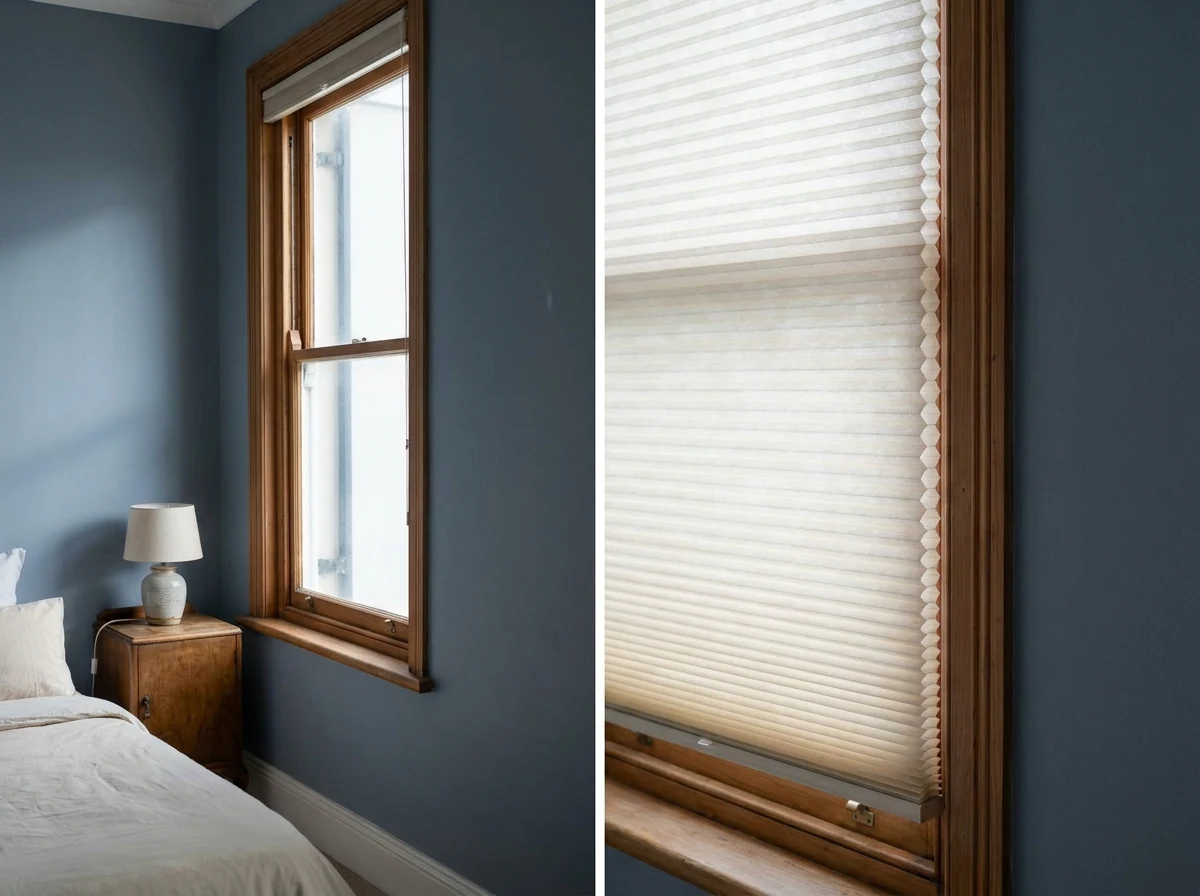
A cellular or honeycomb blind is a pleated fabric that folds into hexagonal cells — a genuine cross-section, not a printed pattern — which trap a layer of still air between the glass and the room. That trapped air is the entire point: it's the closest a blind gets to a thermal layer rather than just a light control.
It earns its place specifically on Tamboerskloof's older housing stock. A single-glazed Victorian sash window is a beautiful thing and a poor insulator by modern standards, and Cape winters bring cold fronts on average once every six days from May to August. A south-facing bedroom or a room above an unheated stairwell can run cold and faintly damp for months in a home like that — the case for trapped-air insulation over a purely decorative treatment.
Where it earns its keep
- South-facing rooms in an original Victorian — the coldest, most consistently draughty exposure on the slope.
- Bedrooms above unheated spaces — a stairwell, a garage, an old scullery.
- Nurseries — a stable, softer temperature swing than a plain roller gives.
- Skylights and roof glass — heat gain in summer is as real a problem as heat loss in winter; guided cellular systems hold flat at an angle.
Top-down, bottom-up
Most cellular blinds can be operated from either end — lower the top for privacy while keeping the sky and light at the bottom, or raise from the bottom for privacy with light from above. On a street-facing sash window overlooked by a neighbour's balcony, that flexibility does real work.
Fits inside the reveal
Like a roller blind, a cellular blind mounts inside the window opening — a furnishing decision on the frame, not a change to the facade, so it sits outside heritage and body-corporate approval processes that apply to exterior fixings.
We measure and fit cellular blinds across Tamboerskloof and the rest of the City Bowl — Oranjezicht, Higgovale, Gardens and Vredehoek.